Who's Really Getting Paid?

This lesson explores creator platforms like OnlyFans that target young people through manipulation and false promises of 'empowerment'.

Learning intentions:

  • Analyse how social media algorithms promote specific economic outcomes for content creator platforms
  • Critically evaluate the difference between individual "choice" and structural/economic pressures
  • Recognise manipulation tactics in digital content promotion
  • Discuss gender dynamics in digital platform economies without shame or judgment

Digital Educator: Joe

  • 12-30 learners

    Class size
  • 11+

    Year Level
  • 45minutes

    Course duration
  • One

    Student Handouts

    Preparing for the lesson

    Information
    Resources
    ACHPE Objectives
    UNESCO Objectives
    Safety & Wellbeing
    Sequence
    Extension
    In this Who's Really Getting Paid? lesson, students will build critical thinking skills, and addresses the sensitive topic of 'sexual content creators' using concrete situations rather than abstract discussions, which can feel more engaging and less judgmental.

    Students will start with a brief knowledge sharing on the types of promotional content and messaging they see in their feeds for sites like OnlyFans. They will then begin deeper discussions around the motivations of these promotions and the realities of making money online, particularly through sexualised content. Using real world scenarios students will work in small groups to apply a critical analysis framework that explores the influences in people's lives that are exploited through predatory marketing and algorithms, the nature of free choice and empowerment, and the gendered dynamics of platforms like OnlyFans. Students determine how best to support a peer including what referrals might be available in your local area. Students will reinforce their learning through a quick red flag green flag brainstorm, before reflecting on how they will use the tools from this lesson in their digital lives. 

    Each lesson ends with a consolidation activity, inviting students to list 1 thing they have learnt from the lesson, 1 thing they already knew, 1 piece of advice they would share with a friend, and 1 adult or organisation that would be helpful in relation to the lesson topic.  
    Facilitator Printouts

    Student Printouts

    Students will need internet access for this lesson to research support services. 
    Not applicable. 
    Key Concept 1: Relationships
    1.3 Tolerance, Inclusion and Respect.
    • Key idea: It is important to challenge stigma and discrimination and promote inclusion, non-discrimination, and diversity.


    Key Concept 3: Understanding Gender

    3.1 The Social Construction of Gender and Gender Norms.
    •  Key idea: Homophobia and transphobia are harmful to people of diverse sexual orientation and gender identity.


    3.2 Gender Equality, Stereotypes and Bias.

    • Key idea: Gender inequality, social norms and power indifferences influence sexual behaviour and may increase the risk of sexual coercion, abuse and Gender Based Violence.


    Key Concept 5: Skills for Health and Wellbeing

     5.5 Finding Help and Support.
    •  Key idea: Everyone has the right to affordable, factual, and respectful assistance that maintains confidentiality and protects privacy.
    • Students in the class will have had a range of experiences with creator platforms, regardless of whether the content was sexualised or not. If they are struggling with the concept of OnlyFans you can encourage them to think of YouTubers or Influencers they might follow and what promotional content they see about joining these platforms.
    • There may be students in your class who are already considering platforms like OnlyFans as an economic or career option. It is important to remind the class that this lesson is focused on analysing systems, not people. There is an additional note about sex work in the Facilitator Cheat Sheet. 
    • You may also need to use protective interrupting if students start to share stories of recruitment. However, it is important to encourage sharing of what they have seen as strategies just not more detailed experiences eg. "When I signed up" or "I know Kate who was in Year 12 last year does it" will need to be interrupted whilst "I've noticed the longer I'm scrolling the more types of this content I see" is a valuable share.  
    • Be mindful of students looking visibly uncomfortable. Some students will have experienced various forms of Image Based Abuse in which their intimate image (or generative AI version) will have been created or shared without their consent, sometimes to platforms that sell pornography and sexual content. Others will have been forced to make child exploitation material by an adult grooming or abusing them. Although this is a light hearted lesson exploring systems and capitalism it is worthwhile monitoring emotional safety and having a word with the school counsellor prior to running this lesson. 
    1. Using a range of media or approaches, students can explore the question: 

      What responsibility do platforms like Instagram/TikTok have in promoting content that targets young people economically?

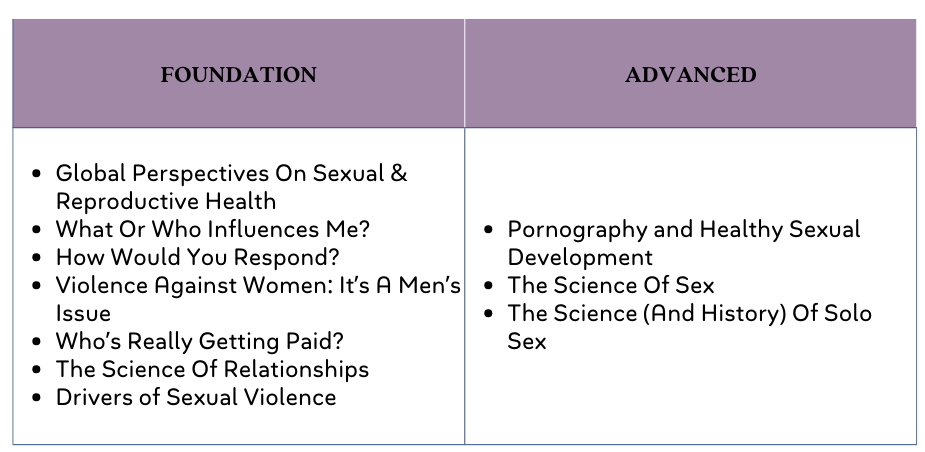
    Ideally, you will have scope to deliver all of the lessons in your program. However we understand that many schools have limited capacity to do so.

    In Year 11 and 12 you can deliver lessons from either year level. It can be helpful for Year 12's to explore more foundational issues in the Year 11 curriculum. It is also beneficial for Year 11's to have access to more advanced lessons from the Year 12 curriculum.  

    Should you find yourself having to implement part of this program, we have provided a suggested sequence of lessons within the broader skills and knowledge categories of relationship, consent, gender, and health & legal literacy. We recommend delivering at least one lesson from each category.

    1. Group Agreements & Pod Mapping should be the first lesson as per best practice.
    2. The program should finish with Great Debates as it provides an opportunity for students to integrate their learnings with their own values and engage in respectful communication on conflicting views.